

Link collection: (context and content warnings are at the end of the post)
https://batjc.org/files/Pods-Pod-Mapping-Worksheet.pdf
https://www.connectwithoumou.com/radical-mental-health-first-aide/
https://docs.google.com/document/d/1-QfMn1DE6ymhKZMpXN1LQvD6Sy_HSnnCK6gTO7ZLFrE/mobilebasic
As you can probably tell from the exercises I’m drawn to, I’m a big fan of making things concrete. Having lists of resources and needs and people reassures me in times of anxiety and helps me stay focused on more productive mental rabbit trails. “Pod Mapping” is one way of visualizing the ways we support each other, especially in advocacy, disability, and mutual aid contexts. Often our pods are quite small, especially those of us who are house- or bed-bound. But even when I don’t have a lot of resources or connections, doing exercises like these helps me avoid what I call “bunker brain.”
I read a lot of adventure/survival books growing up, so when I get anxious, it doesn’t take long for me to start thinking about which part of our backyard we should dig up for a storm shelter or how many mason jars of fermented carrots we need to feed ourselves for a year. My spouse hates both digging and carrots and does not enjoy those hypotheticals, and I suspect they are also not doing my mental health much good. When I channel that energy into thinking about the people I’m connected to, I’m able to turn my thoughts towards the ways we care for each other and to how I can expand that circle of care. The bunker thoughts and the community-building thoughts are both mostly in my imagination - I don’t have the resources or energy to make either happen on my own right now - but thinking about community care and support instead of fortifying our backyard is probably a better use of my mental energy.
What are Mutual Aid Pods?
Most people probably remember “pods” as small social or schooling groups people formed during COVID. Very few of us were lucky enough to be able to reduce our risks in that way, but it’s fascinating to think about how people organized to meet fundamental needs during tumultuous times.
The idea of mutual aid pods actually goes back more than a decade, when Mia Mingus at the Bay Area Transformative Justice Collective (BATJC) developed the idea of social pods to improve accountability and support in activist and justice work. This then grew into the idea of mutual aid and disability support pods. These diagram the web of connections and resources we rely on. Resources can be everything from money and tools to information, research, skills, recreation, emotional support, physical proximity, and time.
I learned about this concept (like much of what I’ve shared so far) in a workshop by Leah Lakshmi Piepzna-Samarasinha. Leah shared a disabled pod mapping resource created by disabled activist, Rebel Sidney Black, who sadly passed away in 2023. I am very grateful for Rebel’s innovative contributions to disability justice and survival, and I’ve linked their original google doc (and the BATJC’s document as well) at the top and bottom of this page.
Before we begin the actual pod mapping exercise, it’s important to remember that this will look very different for each person - and also different for each person you connect with! It’s not possible to offer the same type or level of emotional or physical support to every person in our pod, especially for those of us with energy-limiting chronic illnesses. Mutual aid is not transactional or perfectly reciprocal. We are building a different kind of community with this exercise - one that honors each person’s unique skills, gifts, and capacity rather than making everyone conform to one standard. This exercise is also a great prompt to have conversations with those in our circles of care about how our current arrangements are working and ways we can collaborate to meet everyone’s needs.
The Exercise
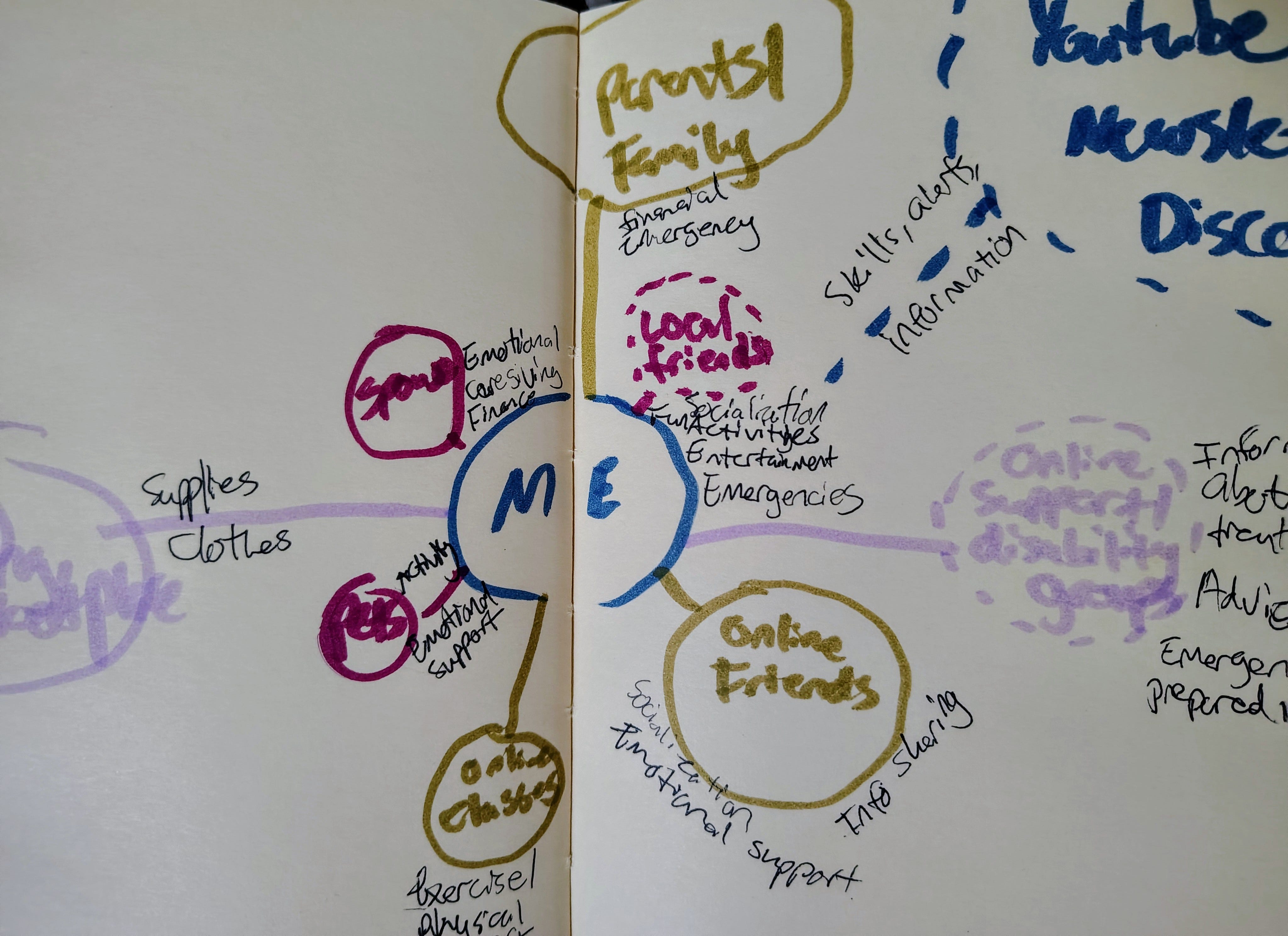
Disability pod mapping goes like this: draw a circle with your name in it in the center of your note-taking platform of choice. Then think about the people you can count on in emergencies or for long-term support. For most of us, as the BATJC points out, that may only be one or two people, if any at all. Write down their names as well as the ways they’ve supported you in the past (emotionally? with physical tasks? taking you to appointments? emergency assistance?).
A little further out, add more circles, but draw them with dotted lines around the edges. These are the people that might be willing to join your pod after a few intentional conversations about resources, needs, and goals. Then, in the corners, add another layer of circles for any larger organizations or groups that provide specific assistance - this can include Buy Nothing groups, local collectives, libraries, search engines, PubMed, or any place you’ve found support when you have questions or needs! Finally, add lines between you and each circle, and in a few words describe the type of support you typically look for and receive from each person or group.
Support can include long-term physical support (caregiving, driving, picking up groceries, yard or housework, childcare), emergency support (pet sitting, picking up cold or flu supplies, taking you to the hospital), and everything in between (socialization, connection, emotional support, advice, information sharing, entertainment/fun, providing storage space…). There will also probably be noticeable gaps, and that’s OK. It’s just a place to start.
You can do this exercise simultaneously with others, but if you’re the sort of person who’s interested in an activity like this, there’s a good chance you’re also the sort of person who’s used to primarily giving support and struggles to receive it. Or, at least, you might have been that person before you got sick. If this is you, I encourage you to map your pod on your own first and consider what sort of things you would need to survive in an emergency (or to thrive when there isn’t one) and write those down.
This is not to be transactional or to look for people who can meet those specific needs, but to become aware of and open to receiving the things you need if or when the offer appears. If you struggle with receiving care, Oumou Sylla is another writer I’ve learned a lot from. Her work encourages people to develop explicit care plans with each other and even “care menus” that you can select from in different situations. (I’d also love to do this as an exercise soon if people are interested!).
Once you’ve mapped your pod, whatever it looks like, consider sharing the exercise with others, especially caregivers and those closest to you, and think about the things you can offer them as part of their pod. Obviously, not all relationships are this straightforward, and in a lot of cases it can be awkward to try to codify them in this way. But this is just the beginning. What if we made disaster care pods? Childcare pods? Medical pods? Not to mention broadening our understanding of support - so many of us find connection in our pets, nature, the earth, and the people who came before us. Our breath is a support. We are always part of a larger, interconnected, living, breathing system, and exercises like this are one way to help us find our place inside of it.
If you do this exercise and want to participate in the comments next week, I’d love to hear any thoughts or feelings it brought up! Would you organize it differently? If you’ve been able to expand your pod, how did you do it? What are some things you and those in your pod do to support each other?
Be well, friends <3
Resources:
1. The BATJC’s original PDF explaining how to develop pods for accountability and support (content note for discussion of community and interpersonal violence): https://batjc.org/files/Pods-Pod-Mapping-Worksheet.pdf
2. Rebel Sidney Black’s google doc about mutual aid pod mapping, including a printable pod mapping worksheet. https://docs.google.com/document/d/1-QfMn1DE6ymhKZMpXN1LQvD6Sy_HSnnCK6gTO7ZLFrE/mobilebasic
3. Oumou Sylla’s website which has many resources about co-creating care (content note for s*icide, as she writes beautifully and compassionately about how to care for yourself or others with s*icidal ideation in her Radical Mental Health First Aid course and other writings): https://www.connectwithoumou.com/radical-mental-health-first-aide/
For anyone listening to the audio version, these links are also at the top of the notes for easy accessibility!


